Why Counting on Fingers Is Not a “Childish Weakness” but a Foundation of Mathematics
Finger counting is often viewed as a primitive strategy, yet decades of cognitive research suggest that finger representations play a fundamental role in the development of numerical understanding, arithmetic skills, and mathematical thinking.
Abstract
Finger counting is commonly regarded as a temporary aid that children should abandon as soon as they learn formal arithmetic. However, research in cognitive science, developmental psychology, and neuroscience suggests a different perspective. Studies have shown that finger representations contribute to the development of numerical cognition, support the acquisition of arithmetic skills, and may serve as a bridge between sensorimotor experience and abstract mathematical concepts. The ability to recognize, differentiate, and mentally represent one’s fingers—often referred to as finger gnosis—has been associated with mathematical achievement across childhood. Neuroimaging findings further indicate overlapping neural networks involved in both finger representation and numerical processing. This article reviews the evidence supporting the role of fingers in mathematical development and discusses why finger counting should be viewed not as a sign of weakness, but as one of the foundational mechanisms through which humans learn to understand numbers.
Introduction: What Is Finger Gnosis and Why Does the Brain Need It?
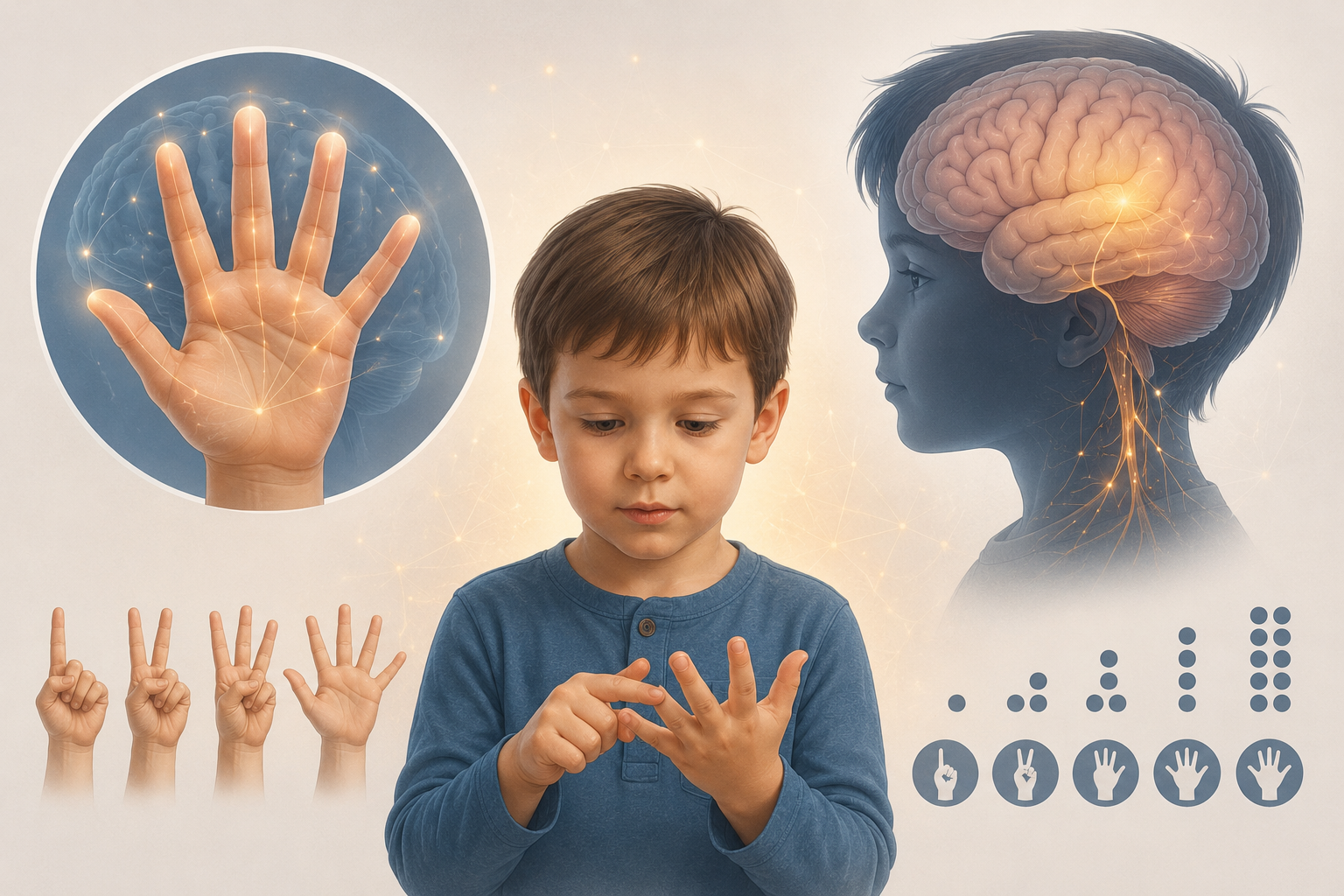
Finger gnosia refers to the ability to recognize, differentiate, and mentally represent one's own fingers without visual guidance. In simple terms, a child can identify which finger is being touched or raised even without looking at the hand. This is not merely a sensory skill. It represents an important stage of cognitive development.
During early childhood, fingers become:
- the first counting tool;
- a means of representing quantity;
- an external support for working memory;
- a bridge between concrete and abstract thinking.
When children count objects while simultaneously raising their fingers, they synchronize:
- object perception;
- motor actions;
- number sequences;
- quantity representations.
At this stage, fingers function as an external memory system, reducing cognitive load and helping children maintain counting sequences.
The Relationship Between Finger Gnosis and Mathematical Ability
Numerous studies have demonstrated that finger gnosia measured at the beginning of first grade predicts later performance in arithmetic, particularly in addition and subtraction tasks.
Importantly:
- no comparable relationship has been found for reading ability;
- children who effectively use their fingers as representational tools perform better in mathematics;
- training finger differentiation improves both finger gnosia and numerical performance.
These findings suggest that the relationship between fingers and mathematics is specific to numerical cognition. Rather than being a simple aid, fingers appear to form part of the neurocognitive architecture underlying numerical understanding.
Typical Developmental Progression of Finger Counting
The use of fingers is not a developmental delay. It is a natural stage of numerical development. A typical developmental trajectory is as follows:
Ages 4–5
Children actively count on their fingers. Fingers serve as the primary tool for representing quantity.
Age 6
Mental calculation begins to emerge, but fingers are still frequently used as support.
Ages 7–8
Most children can perform simple calculations without relying on their fingers.
After Age 8
Fingers are generally used only for more complex calculations or for tracking intermediate steps.
It is important to recognize that these timelines vary across individuals. Some children internalize counting processes earlier than others.
Do Adults Still Use Their Fingers?
At first glance, it may appear that the relationship between fingers and mathematics disappears in adulthood. Indeed, the observable use of fingers during calculation decreases with age. However, studies employing electromyography (EMG) and transcranial magnetic stimulation (TMS) suggest that the neural relationship between fingers and numerical processing persists. The connection does not disappear entirely; rather, it becomes functionally specialized.
Where the Connection Remains and Where It Disappears
Research indicates that the relationship between hands and mathematical abilities is functionally differentiated. A connection exists between:
- hand representations and sequential counting;
- hand representations and object counting.
However, little or no connection has been found between hand representations and retrieval of arithmetic facts from long-term memory. For example:
- when a person counts “8, 9, 10, 11,” hand-related motor representations remain involved;
- when a person immediately recalls “8 + 3 = 11,” hand involvement is largely absent.
The Passive Hand Movement Experiment
The study Passive Hand Movements Disrupt Adults’ Counting Strategies investigated the role of hand motor circuits in adult arithmetic. Participants solved arithmetic problems using three strategies:
Retrieval
- 8 + 3 = 11 - the answer is directly retrieved from memory.
Transformation
- 8 + 2 = 10
- 10 + 1 = 11
Counting
- 8 → 9 → 10 → 11
While solving the problems, participants either experienced no interference or had their hand passively moved across a four-point matrix. The researchers asked whether disrupting the motor system would affect all arithmetic strategies equally.
Experimental Results
The results were clear. Passive hand movements slowed only the counting strategy. In contrast:
- arithmetic fact retrieval remained unaffected;
- transformation strategies were unaffected as well.
These findings suggest that hand motor circuits are specifically involved in sequential counting rather than in all forms of arithmetic processing.
The Premotor Theory of Counting
These findings are consistent with the premotor theory of counting (Andres et al., 2007). According to this theory, adults do not necessarily move their fingers while counting. Instead, the brain constructs an internal motor plan corresponding to sequential finger movements. In other words, the brain appears to simulate finger movements even when no actual movement occurs. This explains why finger representations remain connected to numerical cognition in adulthood.
Why the Connection Persists Into Adulthood
Children use their fingers:
- to point at objects while counting;
- to represent quantity;
- to track intermediate counting steps.
However, arithmetic facts are typically learned without finger involvement. Embodied cognition theories propose that knowledge is stored together with the sensory and motor experiences present during acquisition. As a result, the motor foundations of counting remain embedded within the adult numerical system
Conclusion
Fingers are not a temporary or arbitrary stage of development. They serve as:
- a foundation for numerical cognition;
- an external scaffold for working memory;
- a mechanism for transitioning from concrete to abstract thought;
- part of the neural architecture underlying mathematics
Even in educated adults, motor representations continue to contribute to specific counting strategies. Consequently, discouraging children from counting on their fingers may prematurely remove a tool that supports the development of abstract numerical understanding.
- Butterworth, B. (1999). The Mathematical Brain. London: Macmillan.
- Butterworth, B. (2005). The development of arithmetical abilities. Journal of Child Psychology and Psychiatry, 46(1), 3–18. https://doi.org/10.1111/j.1469-7610.2004.00374.x
- Dehaene, S. (2011). The Number Sense: How the Mind Creates Mathematics (2nd ed.). Oxford University Press.
- Fayol, M., Barrouillet, P., & Marinthe, C. (1998). Predicting arithmetic achievement from neuropsychological performance: A longitudinal study. Cognition, 68(2), B63–B70. https://doi.org/10.1016/S0010-0277(98)00046-8
- Gracia-Bafalluy, M., & Noël, M.-P. (2008). Does finger training increase young children's numerical performance? Cortex, 44(4), 368–375. https://doi.org/10.1016/j.cortex.2007.08.020
- Noël, M.-P. (2005). Finger gnosia: A predictor of numerical abilities in children? Child Neuropsychology, 11(5), 413–430. https://doi.org/10.1080/09297040590951550
- Penner-Wilger, M., Fast, L., LeFevre, J.-A., Smith-Chant, B. L., Skwarchuk, S.-L., Kamawar, D., & Bisanz, J. (2007). The foundations of numeracy: Subitizing, finger gnosia, and fine motor ability. Proceedings of the Annual Meeting of the Cognitive Science Society, 29, 1385–1390.
- Sato, M., Cattaneo, L., Rizzolatti, G., & Gallese, V. (2007). Numbers within our hands: Modulation of corticospinal excitability of hand muscles during numerical judgment. Journal of Cognitive Neuroscience, 19(4), 684–693. https://doi.org/10.1162/jocn.2007.19.4.684
- Wilson, M. (2002). Six views of embodied cognition. Psychonomic Bulletin & Review, 9(4), 625–636. https://doi.org/10.3758/BF03196322